Photo: Quang Nguyen Vinh / Pexels
Everyone knows Kampot pepper. Fewer people know that, a few kilometres from the pepper plantations, another treasure of the same coast is harvested by hand under the dry-season sun: Kampot-Kep salt.
A coastline shaped by salt
Along the Gulf of Thailand, in the provinces of Kampot and Kep, the land is flat, the soil is sandy loam and the dry season is long and hot. These are ideal conditions for salt pans, and sea salt has been produced here for several centuries.
In April 2023, Kampot-Kep salt was registered as a geographical indication (GI) in Cambodia, the same kind of recognition that protects Kampot pepper. The producers' association then applied to WIPO's Lisbon System in June 2024.
From seawater to crystals
The work follows the rhythm of the seasons. The pans are irrigated in November, at the start of the dry season. They are first cleaned of the mould and weeds left by the rains, and kept free of chemicals.
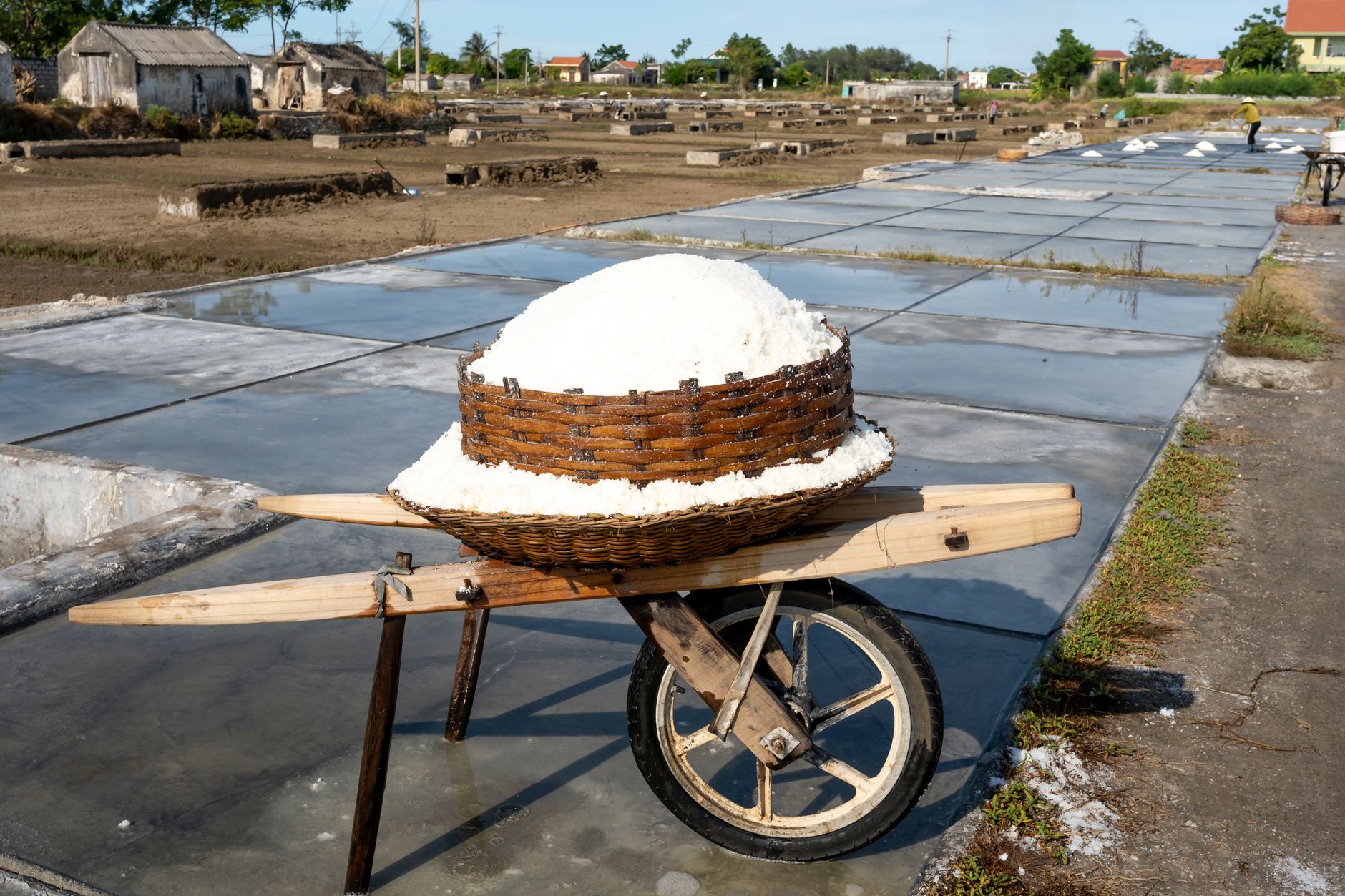
Seawater is then let into retention pans, where evaporation gradually concentrates it. It flows through a series of pans before reaching the final harvesting pans. There, about a week of intense sun is enough to evaporate most of the water, and the harvesters gather the salt crust.
The harvest runs from December to April. The salt is unrefined and has no additives, except for iodine, which Cambodian law requires.
Coarse salt, fleur de sel, flakes
The producers offer several forms of the same salt:
- Coarse salt, from evaporated seawater;
- Fleur de sel, gathered from the surface of the pans;
- Flakes, made from brine;
- Fine salt, obtained by grinding the coarse salt.
The taste is gently crunchy, less salty than refined salt and slightly sweet. According to the producers' association, it contains more than 80 minerals and trace elements, including magnesium, potassium, iron and zinc.
A demanding craft with an uncertain future
Behind each crystal, there are families. Some farm five hectares with a handful of relatives, others over twenty. The work is physically hard, the margins are modest and the income is seasonal, so young people are reluctant to take it up.
Climate change adds to the pressure: unpredictable rain can wash away the pans and cut yields in half. Cheaper industrial salt from neighbouring countries and online counterfeits complete the picture. Registering the GI is a first step towards protecting this heritage.
On the table, with a turn of pepper
At Inspiration D'Asie, we love this pairing: Kampot salt and Kampot pepper come from the same coast and the same dry-season sun. Sprinkle a pinch of fleur de sel on a ripe mango, on grilled fish or on a chocolate dessert, add a few grains of freshly ground pepper, and you taste the Gulf of Thailand.
Visit one of our shops in Aix-en-Provence, Avignon or Cannes to discover our Cambodian pepper and ask our team for pairing ideas.