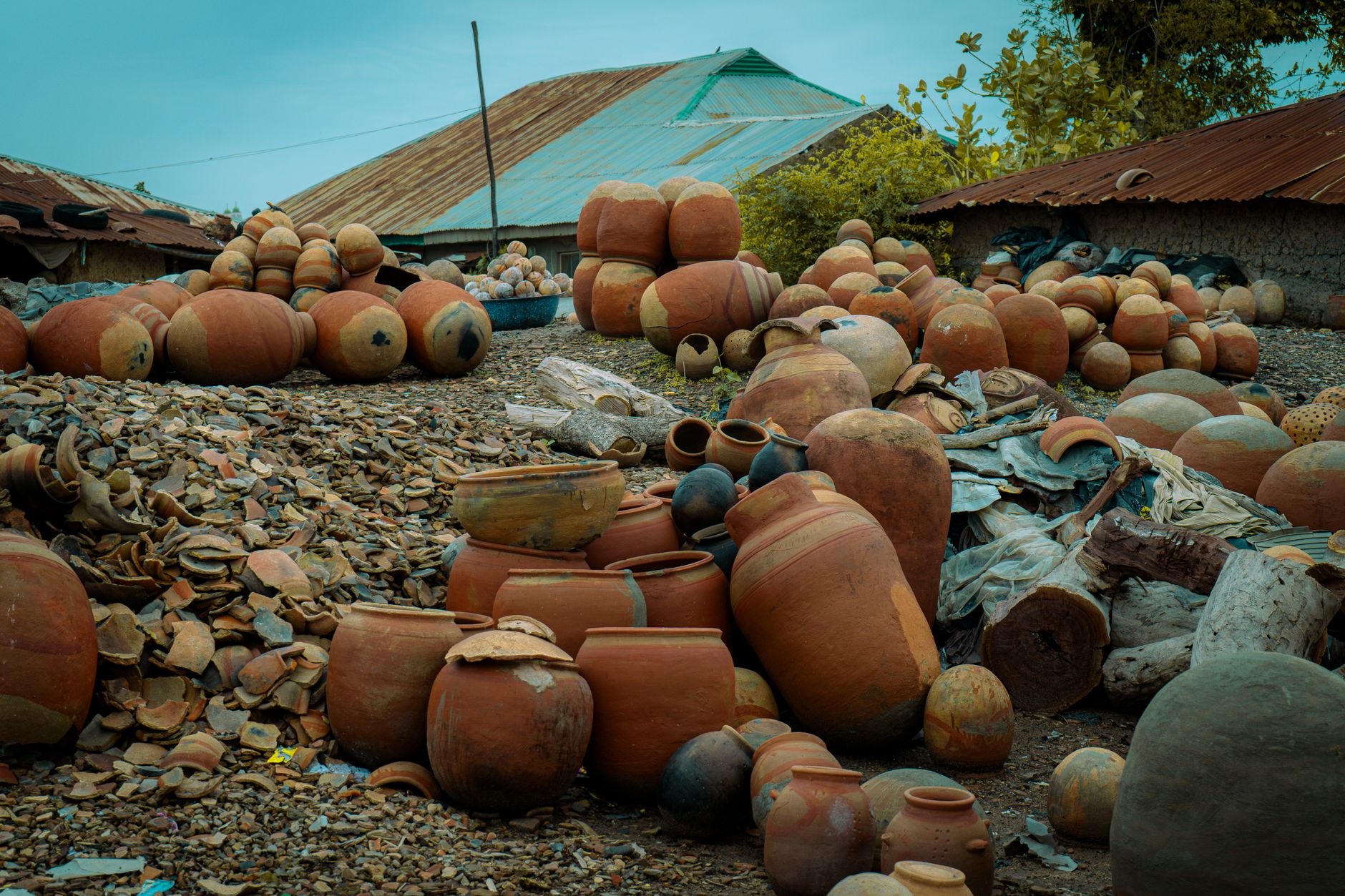
Photo: Silvanus Solomon / Pexels
The "pottery port"
Its name literally means "port of the jars", and it lives up to that title. Kampong Chhnang, a province on the shore of the Tonle Sap lake a few hours from Phnom Penh, has for centuries been the beating heart of Cambodian pottery. Archaeologists have dated kilns and shaping tools found in the region to the 6th century: a craft passed down almost without interruption for more than 1,500 years.
The village of Andong Russei, nestled at the foot of a small mountain, concentrates most of this tradition. Almost every household there works with clay, extracted right nearby, on Krang Dei Meas mountain, which provides a particularly fine and pure earth.
A technique without a potter's wheel
What stands out most when watching the potters at work — for here they are, almost exclusively, women — is the complete absence of any electric or even manual wheel. The technique, known as "paddle and anvil", involves placing a ball of clay on a palm-tree stump, then walking around it while shaping it with regular blows of a wooden paddle, while a hand inside the piece acts as an anvil to stretch and reinforce the walls. It is the potter who walks around the object, not the other way round.
This gesture requires jeweller's precision: at this stage, the wall is still fragile, and the slightest mistake can pierce or crack the piece. Once the shape is achieved, the jars and pots dry in the sun before being fired in the open air, on a bed of straw and wood, using methods just as ancient as the gesture itself.
From everyday jars to decorative pieces
Traditionally, this pottery served mainly domestic purposes: jars for rice, water, fish sauce, cooking pots. Today, while plastic has replaced some of these utilitarian uses, the artisans of Kampong Chhnang have also turned to more decorative pieces — vases, lamps, sculpted objects — to keep this craft alive for visitors and buyers from Phnom Penh.
A craft that remains fragile
Like many Cambodian manual trades, Kampong Chhnang pottery has to contend with younger generations moving to factories and cities. But the know-how holds on, carried by whole families and by growing tourist interest in these artisan villages, which can be visited on a day trip from Phnom Penh or on the way to Battambang. Watching a potter shape an entire jar in just a few minutes, without a single mechanical tool, remains one of the finest lessons in craftsmanship that Cambodia has to offer.